

Your Fixed Rate Is Expiring in a 7% World: Sell, Refinance, or Reposition?
A decision guide for Seattle investors who bought small multifamily in 2019–2022
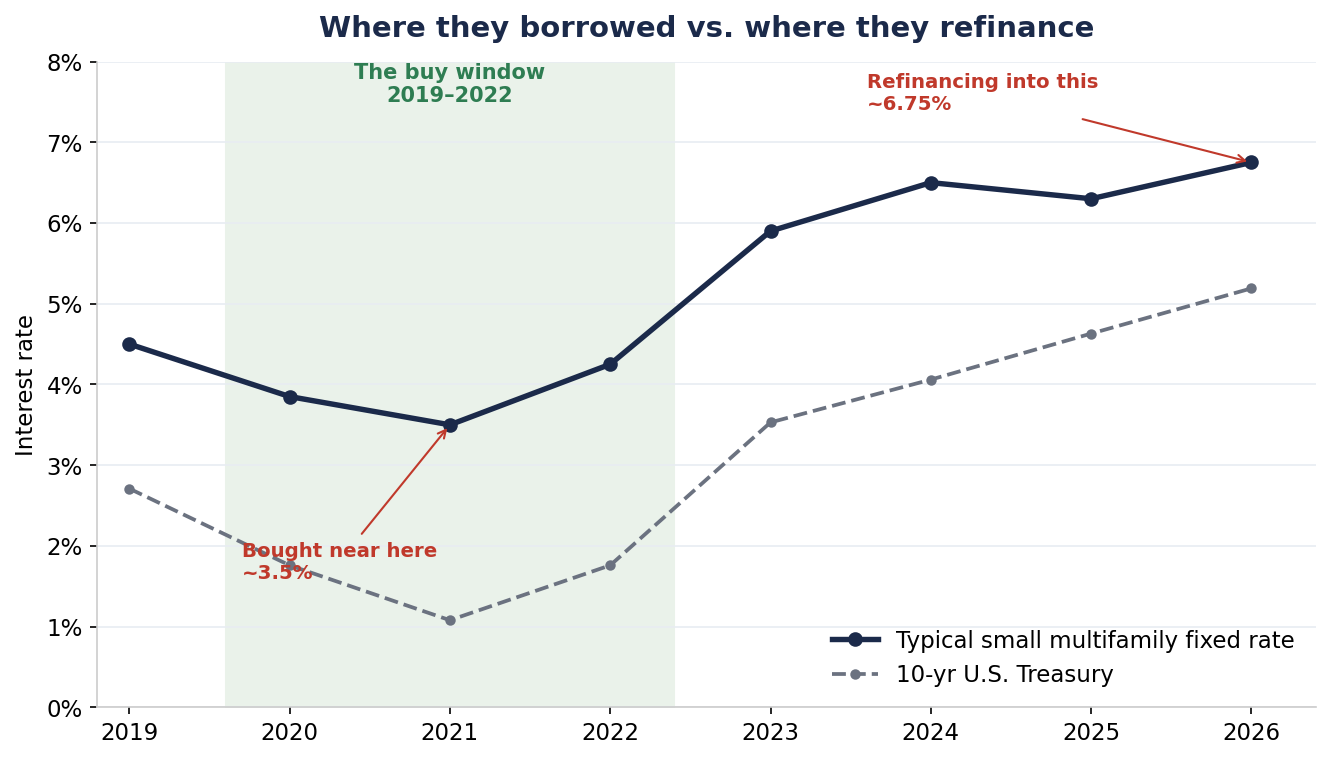
If you bought a small apartment building in Seattle between 2019 and 2022, you did everything right at the time. You locked a low fixed rate, believed in the rent story, and the numbers penciled. Now your 5- or 7-year fixed term is coming due, and a building bought into a 3.5% world has to survive a nearly 7% one.
The goal here isn’t to scare you — it’s to show you, with real numbers, how the move in rates and cap rates has changed your equity position, then walk through your three honest options: sell, refinance, or reposition.
How we got here
The cheap-money window of 2019–2022 was historically unusual. The 10-year Treasury — the benchmark most multifamily debt is priced over — fell to roughly 1.08% at the start of 2021, and small multifamily borrowers were signing fixed-rate notes in the 3.5%–4.0% range. Today that Treasury sits around 5.2% (its highest since 2007), and a typical fixed rate on a sub-$6M apartment loan now runs 6.4%–7.1% — call it roughly 6.75%. You didn’t do anything wrong — you financed an asset at the bottom of a rate cycle, and the bill is coming due at the wrong moment.
Three things went sideways at once
Rates are only part of the story. For the 2019–2022 buyer, three forces compounded.
Rents came in flat: after the one-time 2021 surge, Seattle rent growth moderated hard — average citywide rent is hovering near $2,000/unit in mid-2026, up only low single digits and essentially flat for several quarters as new supply delivered. If you underwrote 4–5% annual growth, you’re well behind.
Expenses ran the other way, fast: multifamily insurance premiums roughly doubled between 2021 and 2024, and property tax reassessments pushed the other big line item up. Flat revenue minus rising expenses equals NOI that’s stuck or shrinking, even on a well-run building.
And COVID broke the middle of your hold: moratoriums, delinquency, and turnover meant many owners never hit the income ramp the pro forma assumed, losing a year or two of the compounding they needed to build equity ahead of this refinance.
If you bought with heavy leverage and operated loosely, those forces quietly ate your cushion. Here’s what that looks like in dollars.
Show me the math: a 12-unit Seattle example
Take a realistic Class C building purchased in 2021.
Illustrative example · 12 units · Class C
Purchased in 2021, valued today
| At purchase (2021) | Today (2026) | |
|---|---|---|
| Net operating income (NOI) | $127,500 | $132,000 |
| Market cap rate | 4.25% | 6.50% |
| Property value | $3,000,000 | ~$2,030,000 |
| Loan balance | $2,100,000 (70% LTV, 3.75%) | ~$1,891,000 |
| Owner’s equity | $900,000 | ~$139,000 |
Look closely. NOI actually ticked up slightly — the operator wasn’t asleep. But because the market cap rate widened from 4.25% to 6.50%, the same income stream is now worth far less. Value fell nearly $1,000,000 while the loan barely amortized, and all of that loss came straight out of equity.
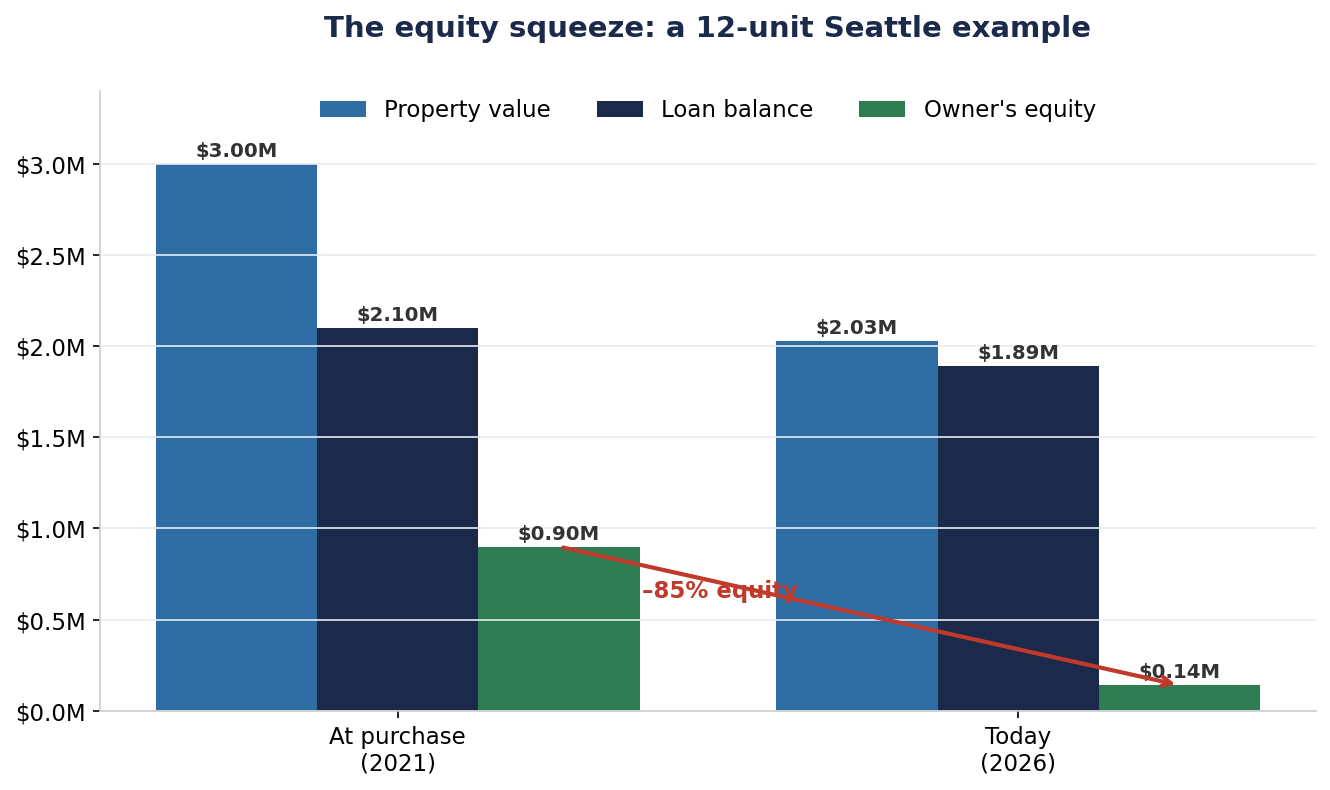
Equity dropped from $900,000 to roughly $139,000 — an 85% decline — with no operational mistake. The loan that started at 70% loan-to-value now sits near 93% LTV, and that single number is why the refinance is hard: no conventional lender hands you a 93% loan today.
This is the heart of the decision. Rising rates pushed cap rates up; higher cap rates pushed value down; lower value erased your equity cushion — and the thinner the cushion, the fewer options you have when the loan comes due. So let’s go through them.
Option 1: Sell
Selling stops the bleeding and removes refinance risk entirely, but you crystallize the loss. At a $2,030,000 value, after ~5% in transaction costs and paying off the ~$1,891,000 balance, the owner nets only about $38,000 — versus the $900,000 they put in. At today’s rates the sale barely clears the debt, which is exactly why waiting for “one more year” is so dangerous: a little more cap-rate drift and this owner is underwater.
Selling still makes sense when you’re over-leveraged across multiple deals, you don’t have the capital (or appetite) to inject more, or the asset has a structural problem — bad location, deferred maintenance, functional obsolescence — that no operating skill can fix. Walking away with your time back and no further capital at risk can beat feeding a property that won’t recover on your timeline.
Option 2: Refinance as-is
If you love the building and want to hold, you still have to clear today’s lending box. Two tests govern how big a loan you can get, and the lower of the two wins:
- Loan-to-value: lenders typically cap around 75%. On a $2.03M value, that’s ~$1,523,000.
- Debt service coverage (DSCR): at a 6.75% rate and a 1.25x coverage requirement, $132,000 of NOI only supports about $1,357,000 of debt.
DSCR is the binding constraint, so the building supports roughly $1.36M — but you owe $1.89M. That’s a ~$535,000 gap you’d bring in cash at the closing table just to keep the property (a “cash-in” refinance). Note how the higher rate widened that gap: a year ago at 6% it was closer to $425,000; every increase in rate shrinks the loan the same NOI can carry. This makes sense only if you have that capital and believe the building is already at its ceiling. For many owners, writing a check this size to refinance into a higher payment with less equity feels like throwing good money after bad — which is why the third option exists.
Option 3: Reposition, then refinance
This is the option most owners overlook, and often the best one if you have runway and capital. Instead of refinancing a tired building at today’s depressed value, you spend deliberately to force NOI higher, rebuild value, and then refinance from strength.
Say you invest $300,000 — roughly $25,000/unit — into unit renovations, targeted common-area work, and burning off loss-to-lease. If that lifts stabilized NOI from $132,000 to $165,000:
Illustrative example · $300,000 reposition
As-is vs. after repositioning
| Today, as-is | After repositioning | |
|---|---|---|
| Stabilized NOI | $132,000 | $165,000 |
| Value at 6.5% cap | $2,030,000 | $2,540,000 |
| Supportable refinance loan | ~$1,357,000 | ~$1,696,000 |
You’ve created roughly $510,000 of new value and rebuilt your equity cushion to about $840,000 — close to where you started. You may still need a modest paydown to fully clear the old balance, but you’ve converted a near-certain loss into a recoverable position and a refinance that’s actually within reach.
The catch is real: repositioning takes fresh capital and execution skill. A renovation program under time pressure, with the maturity clock ticking, is the hardest version of this business. Be honest about whether you have the cash, the contractor relationships, and the discipline to pull it off before the loan comes due.
How to decide — and what to have ready
The right answer depends on two questions: how much fresh capital can you deploy, and how honestly can you operate the asset from here?
- No capital, over-leveraged, or a structurally flawed asset → lean toward selling before the maturity forces a worse outcome.
- Capital available, building already maxed out → a cash-in refinance keeps the asset if you believe in the long-term Seattle thesis.
- Capital available, real upside left in the rents, and the discipline to execute → reposition, then refinance is usually the highest-return path.
Whichever door you’re leaning toward, get ahead of it — don’t wait until 90 days before maturity. Have these ready now: a current trailing-12-month operating statement, a realistic rent comp analysis, a fresh broker opinion of value, and a refinance quote with the actual rate, DSCR, and debt-yield constraints spelled out.
The 2019–2022 cohort isn’t in trouble because they were bad investors. They’re in trouble because the cost of money doubled underneath a flat-rent, rising-expense market. The owners who come out whole will be the ones who run the math early, pick a lane honestly, and move before the calendar decides for them.
Not sure which door is yours? Let’s run your actual numbers.
The example above is hypothetical — your building isn’t. If your loan is maturing in the next 12 to 24 months, the worst move is to wait and let the calendar decide for you. The best move is to know your real options now, while you still have all three on the table.
I help Seattle small multifamily owners do exactly that. Send me your building and I’ll put together a straight, no-obligation analysis of where you actually stand: your current value and equity position at today’s cap rates, what a refinance would really support, and whether a reposition-and-refinance plan pencils for your deal. No pitch — just the math, so you can make the call with clear eyes.
Email Alfred your deal →Alfred Anderson · Pacific Crest Real Estate
Email: alfred@pacificcrestre.com
Web: pacificcrestinvestmentsales.com
Email me directly with your address and a recent rent roll or T-12, or learn more at pacificcrestinvestmentsales.com — and I’ll take it from there.
- Multpl – 10-Year Treasury Rate (monthly, Oct 2026)
- Select Commercial – Commercial Mortgage Rates (Oct 14, 2026)
- Northmarq – Commercial Mortgage Rates & Spreads
- Kidder Mathews – Seattle Multifamily Market Report
- RentCafe – Seattle Average Rent Trends
- Federal Reserve – Rising Property Insurance Costs for Apartment Buildings
- PREA – Multifamily Property Expenses Rising, Led by Insurance