
Seattle’s RUBS Debate Is Missing the Point
Utility costs do not disappear. The real question is how fairly, transparently, and predictably they are allocated.
If you read the current public conversation around RUBS in Seattle, you would think the entire issue is simple: tenants are being hit with confusing charges, landlords are using formulas instead of exact usage, and the obvious answer is to shut the system down.
I don’t think it’s that simple.
And I think a lot of people reading the headlines feel the same way, even if they haven’t said it out loud yet.
Step back from the rhetoric and a more grounded reality comes into focus: utility costs are real, they have to be paid somehow, and every billing method involves tradeoffs. The conversation in Seattle right now is treating those tradeoffs as if they don’t exist. That is not helping renters, and it is not helping housing providers either.
Seattle already regulates RUBS and other third-party utility billing practices in buildings with three or more units. The city’s ordinance — Seattle Municipal Code Chapter 7.25 — requires written notice to tenants, disclosure of the billing methodology, itemized bills, a formal dispute process through the Office of the Hearing Examiner, and hard caps on service charges. Access to the underlying master utility bill is available through the dispute and audit process. In January 2026, the Seattle Renters’ Commission sent a formal letter to the City Council and Mayor urging Seattle to ban RUBS outright and require non-submetered utilities to be built directly into rent. Landlord groups and housing providers have pushed back publicly in response. No Council vote has taken place. The advocacy phase is where we are right now, and that is exactly why the quality of this debate matters.
SMC 7.25 · At a Glance
Seattle’s Utility Billing Rulebook Already Exists
Key tenant protections already on the books, effective since 2004.
- Scope. Applies to residential buildings with 3 or more units when utilities are billed to tenants separately from rent.
- Written disclosure. Billing methodology (flat, RUBS, or submeter) and any changes must be disclosed to tenants in writing.
- Itemized bills. Each bill must be itemized, including meter readings for submetered units and the applicable service period.
- No markup on utility cost. Total charges billed to all units cannot exceed the building’s underlying utility bill.
- Service charge cap. Third-party billing fees are capped at $2 per utility per month, with a $5 per-month cumulative cap across all utilities on a bill.
- Late fee limits. Late fees capped at $5 per month, with interest capped at 1% per month.
- Dispute process. Tenants can challenge charges or submeter accuracy through the Hearing Examiner. Overcharges must be refunded.
- RUBS methodology. Allocation formulas may account for occupancy, bedrooms, square footage, or similar criteria.
Source: Seattle Municipal Code Chapter 7.25 (Third-Party Billing Regulatory Ordinance), effective February 2004.
Volatility Is Not the Same as Unpredictability
The first distinction missing from the debate is between volatility and unpredictability.
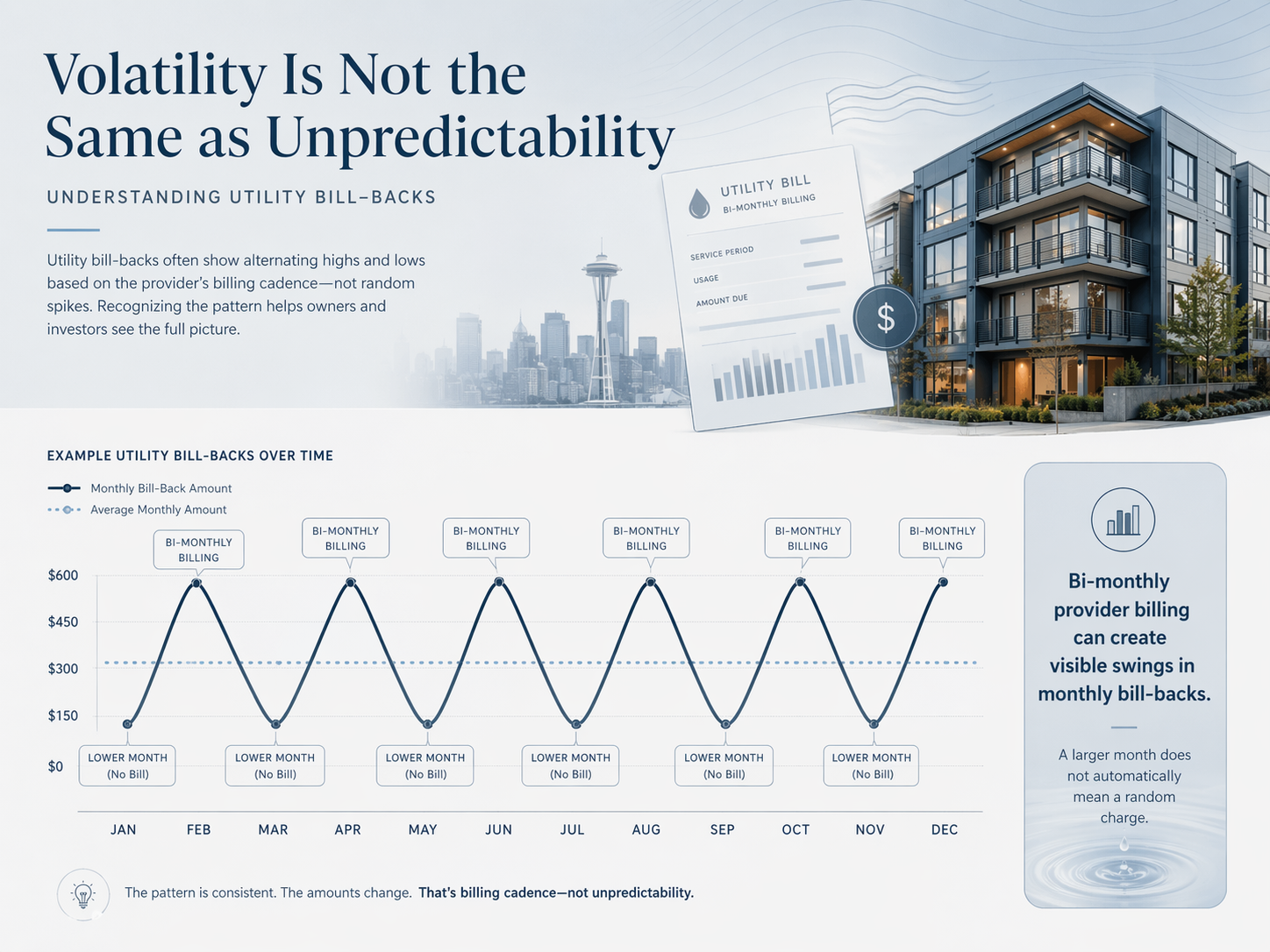
In many multifamily properties, utility providers do not bill neatly every single month. This is not a rhetorical point. Seattle Public Utilities bills residential water, sewer, and solid-waste customers on a bi-monthly cycle — every other month, not every month. That means a typical master-metered Seattle apartment building receives roughly six water, sewer, and garbage bills a year from the city, not twelve. SPU itself warns customers that “extra charges can add up during the 8 weeks between bi-monthly billings,” which is another way of saying the two-month cycle can make a given bill look much larger than residents expect.
When a property then bills residents monthly, that provider cadence produces exactly the alternating highs and lows shown below. The swing is real. The cause is the city’s own billing calendar.
And cadence is only part of it. Rate levels themselves move on the provider side, without any input from the property. SPU resets residential water, sewer, drainage, and solid-waste rates on January 1 each year — the approved 2025–2027 wastewater and drainage rate path alone calls for roughly 5% average annual revenue increases, on top of separate water and solid-waste schedules. On the electric side, Puget Sound Energy’s time-of-use peak windows shift between summer (April–September) and winter (October–March). And actual consumption follows the calendar too: regional water use rises roughly 35–45% from May through September, mostly for outdoor irrigation and landscaping. A pass-through bill that looks different in July than in February often reflects those provider-side moves, not anything the building has changed.
None of this automatically means the charge is fabricated, abusive, or impossible to understand. Sometimes it simply reflects how the property itself is billed, or what rates the providers are currently charging. SMC 7.25 was written with exactly that reality in mind.
That still does not excuse bad communication. If a resident gets a larger-than-expected charge and no one has clearly explained the cadence, the methodology, or the backup, frustration is justified. But that is exactly the point. A bill can be frustrating without being illegitimate. A fluctuating charge is not the same thing as a made-up charge.
A bill can be frustrating without being illegitimate. A fluctuating charge is not the same thing as a made-up charge.
An Honest Discussion of Alternatives
The second thing missing is an honest discussion of alternatives.
Flat-rate utility billing is often more operationally compelling than people want to admit. It is easier for residents to understand, easier for management to bill consistently, and easier to collect. When a utility charge lives on the ledger as a static monthly amount, collections improve. There are also fewer situations where large utility balances quietly accumulate and then eat up most of the security deposit at move-out, leaving little left to cover actual damage to the unit.
Those are real advantages. They matter in the real world.
But flat-rate billing is not automatically more fair just because it is more predictable. In many cases it is less accurate. A studio with one occupant can end up subsidizing a larger household. A light user can end up paying for a heavy user. Simplicity improves. Precision often declines.
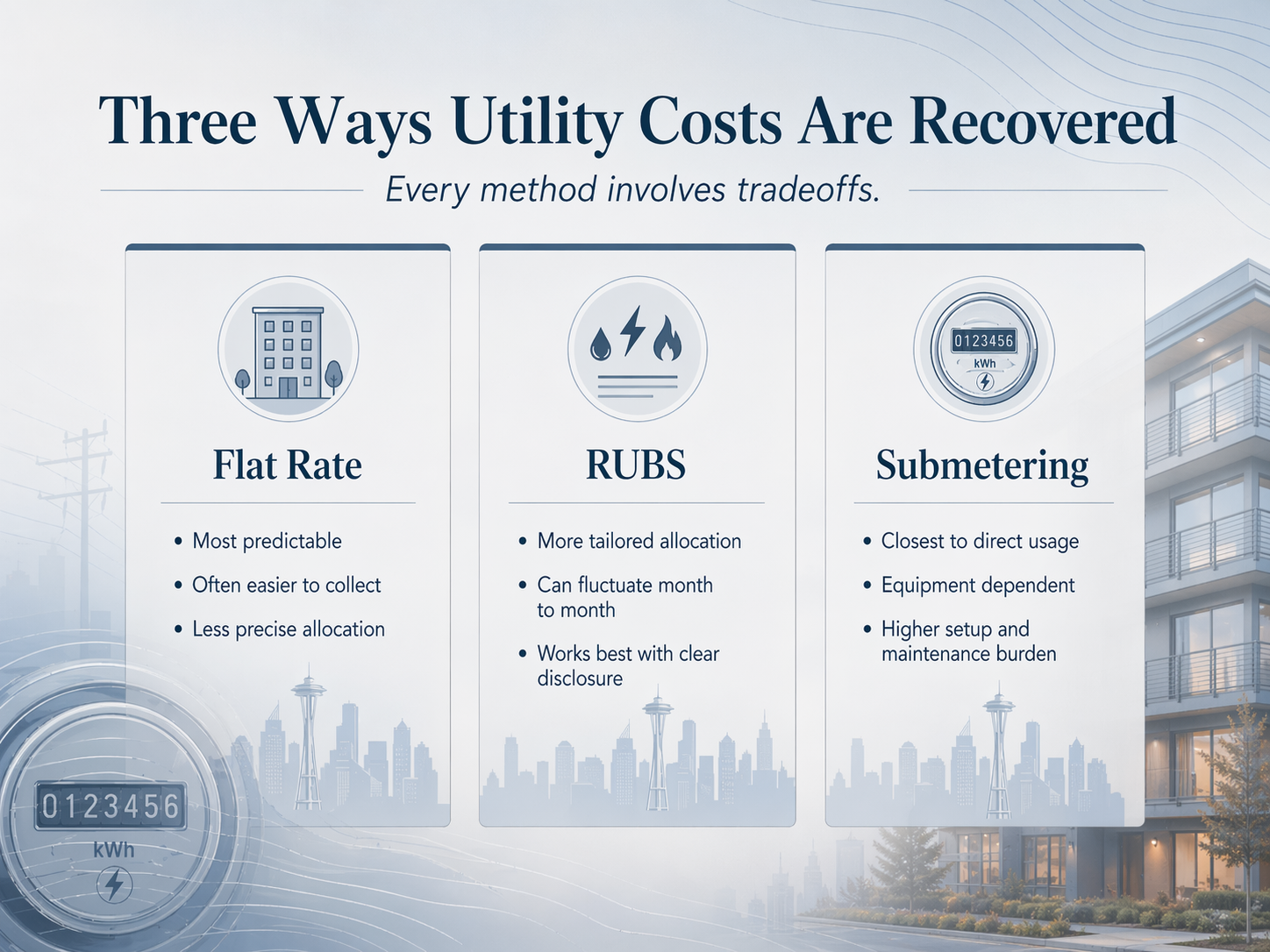
RUBS, by contrast, is not exact metering, but it is at least an attempt to allocate cost with more thought than a blanket flat fee. Seattle defines RUBS as a formula that can account for factors such as occupancy, bedrooms, square footage, or similar criteria. People may disagree with the method, but it is hard to argue that a formula built around multiple factors is somehow less thoughtful than charging everyone the same amount regardless of size or use.
That gets to the heart of the issue.
Why is predictability always treated as more important than accuracy? That is a real policy choice. It is not a moral truth.
And Seattle’s current debate often skips right over that distinction.
Recovery Is Not the Same as Income
Another point that gets blurred: recapturing utility cost is not the same thing as boosting income.
Under SMC 7.25, the total charges billed to all units for a utility service cannot exceed the amount of the building’s underlying utility bill, aside from narrowly defined items — service charges capped at $2 per utility per month with a $5 monthly cumulative cap, late charges, and similar limited items. Those caps are real, specific, and enforceable.
That does not mean every operator, owner, or third-party vendor gets it right. It does not mean abuses never happen. It does mean sweeping claims that RUBS is inherently a way for landlords to “boost income” should be substantiated, not assumed. There is an important difference between recovering real building expense and manufacturing new revenue. A serious policy conversation should respect that distinction.
The same goes for submetering, which is often presented as the obvious clean answer. In theory, billing exact unit usage sounds ideal. In practice, it comes with its own costs and complications. Equipment has to be installed, maintained, read, and periodically tested. SMC 7.25 itself includes a dispute process for submeter accuracy and a refund requirement when a submeter fails accuracy testing. Even “actual usage” billing still depends on hardware, oversight, and administration.
So no, this is not a simple choice between good billing and bad billing.
It is a choice between imperfect systems.
From an operator’s perspective, the answer is rarely ideological. It is practical. Smaller properties experience this differently than larger ones. Larger communities are more likely to outsource utility recovery to third-party billing companies, which can remove administrative burden from on-site teams but also create distance between the resident and the explanation. Smaller properties often feel these issues more directly and more personally. Either way, the operational reality is more nuanced than the public narrative suggests.
How HB 1217 Changes the Conversation
There is a broader legal and economic reality worth acknowledging. After last year’s passage of HB 1217 — Washington’s statewide rent-stabilization law — “rent” and “rental amount” are defined in RCW 59.18.030 as recurring and periodic charges identified in the rental agreement for the use and occupancy of the premises, which may include charges for utilities.
That definition matters enormously for this debate.
If a utility charge is structured through the lease as “rent,” it falls inside the HB 1217 annual-increase cap. If it is structured as a separate RUBS pass-through of the building’s actual bill, it sits outside that cap — because RUBS, by definition, is not setting a rate; it is allocating cost. That is legal under SMC 7.25 when done properly. It is also one of the reasons the Ban RUBS campaign has gained traction: critics argue RUBS has become a way to push rising utility costs onto tenants without those costs counting against the cap. Operators counter that these are real costs someone has to pay, and folding them into rent simply raises sticker-price rents for everyone, including new residents who would otherwise benefit from transparent usage-based allocation.
Both things can be true. That tension is exactly the conversation Seattle should be having — honestly, with the actual numbers in view, rather than as a binary.
What Better Looks Like
If Seattle wants better utility billing outcomes, the answer is not to flatten every issue into one emotionally satisfying headline. The answer is to insist on transparency, clean disclosures, understandable billing cadence, and real enforcement when landlords or billing vendors do not comply. SMC 7.25 already contains most of the necessary machinery. Enforcement and resident education have more leverage here than a blanket prohibition.
Pretending every formula-based allocation system is inherently abusive does not make the conversation more honest. It makes it less honest.

The bottom line. Utility costs do not disappear. They only move. The real question is not whether renters pay them. The real question is whether those costs are being allocated in a way that is transparent, defensible, and workable in the real world. SMC 7.25 already sets a framework for that. Enforcing it well — and making disclosure clearer at the resident level — will do more for Seattle renters than a blanket ban that would simply push utility cost into higher sticker-price rent.
That is the conversation Seattle should be having.